
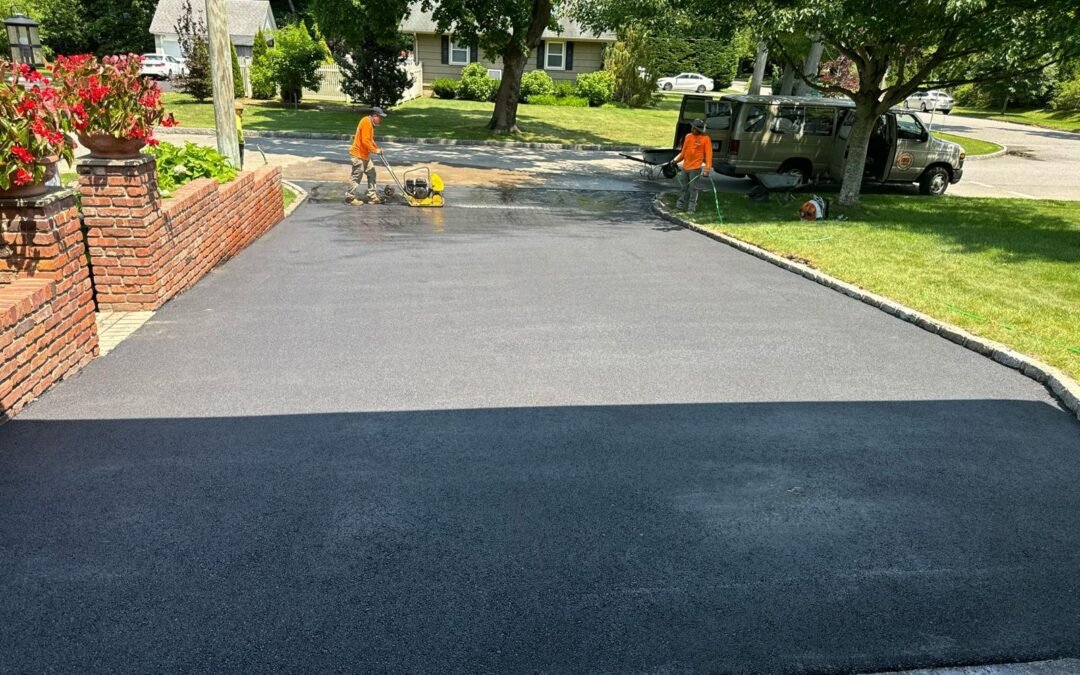
If you own a home in Freehold and your driveway is cracking, sinking, or just looks worn out, you are probably weighing your options. Asphalt driveways in Freehold remain the most popular choice for residential properties across the borough and township, and for good reason. The material handles Monmouth County’s freeze-thaw winters better than concrete, costs less to install, and can be resurfaced instead of ripped out when it reaches the end of its first life cycle.
But not every asphalt job is equal. The difference between a driveway that lasts 25 years and one that starts failing in 5 comes down to base preparation, material thickness, proper drainage, and the contractor doing the work. This guide covers everything a Freehold homeowner needs to know, from realistic 2026 costs to the local permit rules most people overlook.
Why Asphalt Works Well for Freehold Driveways
Freehold sits in Monmouth County, where winters bring real cold. Temperatures regularly drop below freezing between November and March, and the ground goes through repeated freeze-thaw cycles that stress any paved surface. Asphalt is a flexible material. When the soil underneath expands and contracts with frost, asphalt bends slightly instead of cracking the way rigid surfaces do.
The soils in the Freehold area are a mix of sandy loam and clay deposits typical of central New Jersey’s coastal plain geology. Clay-heavy soils retain moisture, which makes proper base preparation and drainage critical for any driveway installation. A well-compacted aggregate base over properly graded subsoil prevents the water retention problems that lead to heaving and premature failure.
Road salt is the other factor. Freehold Borough and Freehold Township both use salt and brine solutions on public roads through winter. That salt gets tracked onto your driveway by every vehicle that pulls in. Asphalt handles salt exposure with far less surface deterioration than concrete, which is prone to spalling (surface flaking and pitting) when exposed to de-icing chemicals repeatedly.
Asphalt Driveway Costs in Freehold for 2026
Paving costs in Monmouth County run close to or slightly above the national average due to labor rates and proximity to asphalt plants in the central New Jersey corridor. Here is what Freehold homeowners can expect:
| Project Type | Cost per Square Foot | Typical 600 sq ft Driveway |
|---|---|---|
| New asphalt installation | $7 to $15 | $4,200 to $9,000 |
| Asphalt replacement (remove and repave) | $8 to $15 | $4,800 to $9,000 |
| Resurfacing (overlay) | $3 to $7 | $1,800 to $4,200 |
| Seal coating | $0.15 to $0.25 | $90 to $150 |
| Crack filling | $1 to $3 per linear foot | Varies by damage |
These figures are based on HomeAdvisor’s 2026 national cost data (average $4,904) and Inch Calculator’s pricing guide, adjusted for the Monmouth County market. Actual costs depend on base condition, site access, drainage requirements, and the time of year you schedule the work.
One tip that saves Freehold homeowners money: if your existing asphalt base is structurally sound but the surface is worn, an overlay (resurfacing) gives you a brand-new driving surface at roughly half the cost of full replacement. A good contractor will evaluate the base before recommending full removal, and an honest one will tell you when a resurface is the better option.
How Long Asphalt Driveways Last in Freehold’s Climate
A properly installed asphalt driveway in Freehold should last 20 to 30 years with regular maintenance. That number is not theoretical. It reflects the performance of asphalt surfaces in central New Jersey’s climate when the base is done right and the homeowner keeps up with seal coating and crack repair.
The biggest threats to asphalt lifespan in the Freehold area are water penetration and UV oxidation. Water that seeps into small cracks freezes and expands in winter, widening those cracks each season. UV exposure during summer dries out the binder that holds the aggregate together, making the surface brittle. Seal coating every 3 to 5 years addresses both problems by filling surface micro-cracks and restoring the protective binder layer.
If you skip maintenance, expect to see alligator cracking (a web-like pattern of interconnected cracks) within 8 to 12 years. Once alligator cracking develops, patching will not solve the problem. The base underneath has likely failed, and you are looking at full replacement.
Asphalt Driveway Maintenance Schedule for Freehold Homeowners
Keeping an asphalt driveway in good shape is straightforward if you follow a schedule. Here is what works in Monmouth County’s climate:
First 6 to 12 months: Do not seal coat a new driveway right away. Fresh asphalt needs time to cure and the oils in the binder need to oxidize slightly before a sealant is applied. Seal coating too early traps those oils and softens the surface. Wait at least 6 months, and ideally a full year.
Every 3 to 5 years: Apply a fresh coat of seal coating. For Freehold properties, staying closer to the 3-year interval makes sense because of the road salt exposure and the freeze-thaw stress. A typical seal coat application on a 600-square-foot driveway costs $90 to $150 when done by a professional.
Every spring: Walk the driveway after winter and fill any cracks wider than a quarter inch. DIY crack filler from any hardware store works for small repairs. Cracks that run deep or span the full width of the driveway should be evaluated by a contractor, because they may indicate base failure.
As needed: Keep the surface clean. Remove oil stains promptly, since petroleum products break down asphalt binder. Clear snow and ice carefully. Metal shovels and sharp-edged plows can gouge asphalt, especially when the surface is cold and more brittle.
What to Know About Freehold Driveway Permits
Permit requirements for driveway work in Freehold depend on the scope of the project and whether any work falls within the public right-of-way. If your project involves modifying the driveway apron (the section that connects your driveway to the street), curb cuts, or sidewalk work, you will likely need a permit from the local engineering or building department.
According to Freehold Township’s municipal code, construction activity within the public right-of-way is regulated and typically requires approval before work begins. All work in the right-of-way must comply with current NJDOT specification standards.
For work entirely on your property (behind the right-of-way line), a zoning permit may be required if you are significantly expanding the paved area or if your lot has impervious coverage restrictions. This is common in newer subdivisions and flood-prone zones. Contact the Freehold Township Building Department before starting work to confirm what is needed for your specific property.
Your paving contractor should be familiar with these requirements and handle the permitting process for you. If a contractor does not mention permits at all, that is a warning sign.
What Separates a Good Asphalt Job from a Bad One
The surface you drive on is only as good as the layers underneath it. Here is what matters for a driveway that performs in Freehold’s conditions:
Base preparation: The subgrade should be excavated to stable soil, graded for drainage away from the house, and compacted. A minimum of 6 to 8 inches of compacted aggregate base goes on top. Contractors who skip or shortchange the base are the single most common reason for early driveway failure. If a quote does not specify base depth and compaction, ask why.
Asphalt thickness: For a residential driveway in New Jersey, you need at least 2.5 to 3 inches of compacted hot mix asphalt. Some contractors lay it at 2 inches to cut costs. That difference might save $500 on a 600-square-foot driveway, but it costs you years of service life. The National Asphalt Pavement Association recommends residential driveways be designed to handle the actual load, and anything less than 2.5 inches will not hold up under daily vehicle traffic in a climate with freeze-thaw stress.
Drainage: Water must move off the surface and away from the edges. A properly graded driveway has a slight crown (high point in the center) or a cross-slope so water sheds to the sides. Standing water on asphalt accelerates every form of deterioration.
Compaction: After the hot mix is laid, it needs to be rolled with a heavy steel drum roller while still at the right temperature. Under-compacted asphalt develops ruts and depressions within the first year. Over-compacted asphalt can crack. This is where contractor experience with the material and local conditions matters most.
Resurfacing vs Replacement: When Each Makes Sense
Not every worn-out driveway needs to be torn up and started from scratch. This is one of the biggest advantages asphalt has over concrete, and it saves Freehold homeowners significant money when the conditions are right.
Resurfacing works when the existing base is structurally intact but the surface shows wear, minor cracking, or oxidation. A new 1.5 to 2 inch layer of hot mix asphalt is applied over the old surface after cleaning and tack coating. This essentially gives you a new driveway for $3 to $7 per square foot instead of the $7 to $15 a full installation costs.
Replacement is necessary when the base has failed. Signs of base failure include large alligator cracking patterns, significant settling or heaving, soft spots where the surface gives under pressure, and drainage that pools on the surface instead of running off. If the base is gone, laying new asphalt on top will only give you a smooth surface for a year or two before the same problems return.
A trustworthy contractor will be upfront about which option your driveway needs. If someone pushes full replacement without checking the base condition, get a second opinion.
Why All Stone Home Improvements Is the Right Choice for Asphalt Driveways in Freehold
All Stone Home Improvements has been providing professional asphalt paving services to homeowners across Freehold and Monmouth County. The team handles every stage, from the initial property evaluation and drainage assessment through base preparation, paving, compaction, and final cleanup.
Every project begins with an honest evaluation of what your driveway actually needs. If a resurface will do the job, that is what All Stone recommends. The company does not push full replacements when they are not warranted, and every quote includes a detailed scope of work specifying base depth, asphalt thickness, drainage grading, and timeline.
All Stone also handles concrete paving, interlocking pavers, seal coating, and stoops and steps, so if your project involves more than just the driveway, one contractor can manage the full scope. The company serves homeowners across Monmouth, Middlesex, and surrounding counties, including Old Bridge, Matawan, and Piscataway.
Ready to talk about your driveway? Request a free estimate and schedule a site visit with a local paving professional who knows Freehold.
Frequently Asked Questions
How much does an asphalt driveway cost in Freehold, NJ?
A new asphalt driveway in Freehold costs $7 to $15 per square foot installed. A typical 600-square-foot driveway runs $4,200 to $9,000 depending on base preparation, site access, and drainage work. Resurfacing an existing driveway costs $3 to $7 per square foot, making it a cost-effective alternative when the base is still solid.
How long does an asphalt driveway last in Freehold?
A properly installed and maintained asphalt driveway in Freehold lasts 20 to 30 years. Regular seal coating every 3 to 5 years and timely crack repairs are the key factors. Without maintenance, freeze-thaw damage and UV oxidation can cut the lifespan to 10 to 15 years.
When is the best time to pave an asphalt driveway in Freehold?
The best paving season in Freehold runs from late April through early November, when asphalt plants are operating and overnight temperatures stay above 50 degrees Fahrenheit. Late spring and early fall typically offer the best conditions and contractor availability in Monmouth County.
Do I need a permit to pave my driveway in Freehold?
You may need a permit if your project involves work in the public right-of-way, such as modifying the driveway apron or curb. Work entirely on your property may still require a zoning permit if you are expanding impervious coverage. Contact the Freehold Township Building Department before starting work.
How often should I seal coat my asphalt driveway?
Seal coat your asphalt driveway every 3 to 5 years. In Freehold, where road salt and freeze-thaw cycles are significant factors, staying closer to the 3-year interval is recommended. Wait at least 6 to 12 months after a new installation before applying the first seal coat.
Can I resurface my asphalt driveway instead of replacing it?
Yes, if the existing base is structurally sound. Resurfacing adds a new layer of hot mix asphalt over the old surface for $3 to $7 per square foot. This extends the driveway’s life by 10 to 15 years. If the base has failed, showing alligator cracking or significant settling, full replacement is necessary.
How thick should an asphalt driveway be?
A residential asphalt driveway should have at least 2.5 to 3 inches of compacted hot mix asphalt over 6 to 8 inches of compacted aggregate base. Thinner installations save on upfront cost but lead to premature cracking and surface failure, especially in areas with freeze-thaw cycling like Monmouth County.
What causes asphalt driveways to crack in Freehold?
The most common causes are water penetration during freeze-thaw cycles, UV oxidation that dries out the asphalt binder, insufficient base preparation, and tree root pressure from nearby landscaping. Regular seal coating and prompt crack repair prevent most of these issues from becoming major failures.
Is asphalt better than concrete for driveways in Freehold?
For most Freehold homeowners, asphalt is the better choice. It costs less to install, handles freeze-thaw conditions better, resists road salt damage, and can be resurfaced instead of replaced. Concrete offers decorative options and a longer theoretical lifespan, but it is more expensive and more vulnerable to cracking in New Jersey winters.
What should I look for when hiring an asphalt paving contractor in Freehold?
Look for active New Jersey Home Improvement Contractor registration, general liability and workers’ compensation insurance, a detailed written estimate specifying base depth and asphalt thickness, familiarity with Freehold’s permit requirements, and verifiable references from projects in Monmouth County. Avoid contractors who quote without visiting the site or who pressure you into signing immediately.